Structure the content
Name, title, summary, experience, projects, skills, education, section order, and section names all live as explicit fields.
In most résumé builders, choosing a prettier template means the words move, wrap, and sometimes get quietly regenerated to fit. Lamr keeps content as structured data and hands it to real Typst templates. Approve the words once, then switch Classic, Modern, Sidebar, or an accent colour — the layout changes and the claims do not.
Classic is a dense single-column document. Modern uses a centred editorial header and more breathing room. Sidebar moves contact details and skills into a dedicated rail. All three read the same structured résumé data — none of them can add a word to it.
Click a template — same structured content, a different Typst layout. Switching costs zero AI credits.
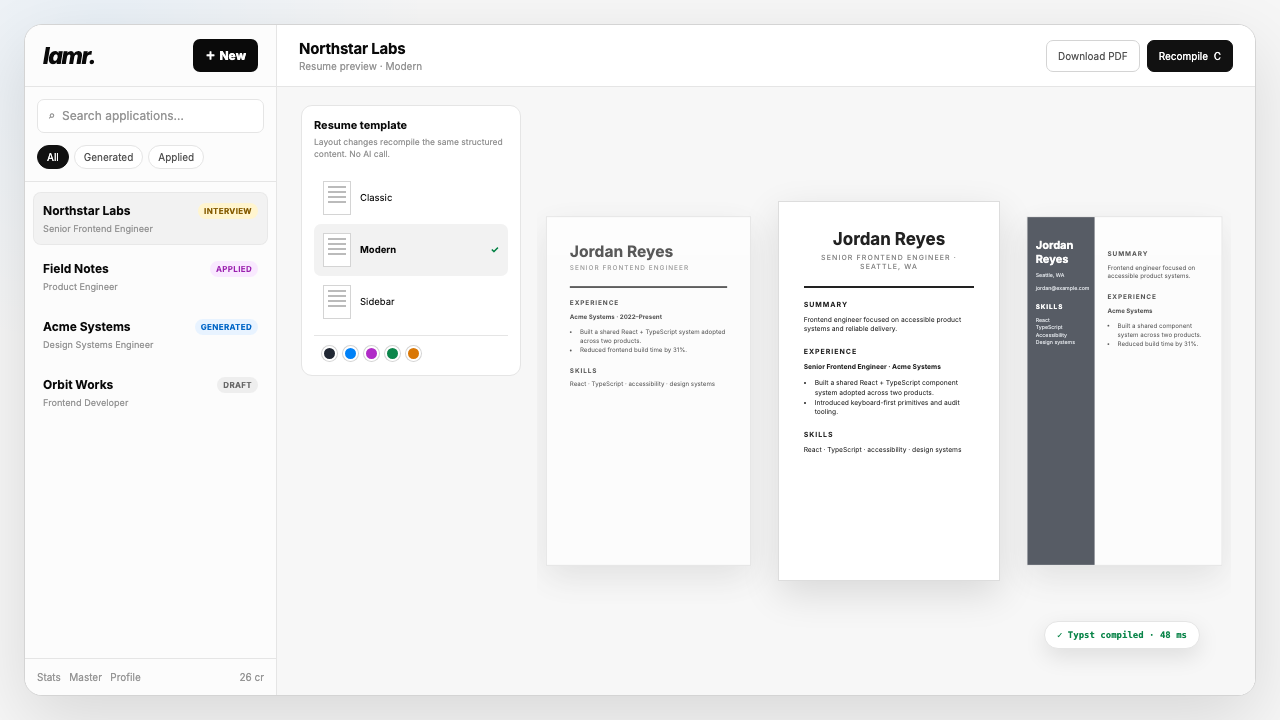
That separation is the whole point. An AI generation changes content and costs credits. A Typst compile applies deterministic layout to already-approved data and does not consume another writing call.
Name, title, summary, experience, projects, skills, education, section order, and section names all live as explicit fields.
Review the tailored language in fields you can change. The structured draft — not a rendered page — is the source of truth.
Choose Classic, Modern, or Sidebar. Modern and Sidebar also accept a controlled accent theme.
Typst produces the PDF. Lamr stores it with the application and keeps recent compile snapshots for later edits.
A candidate approves the tailored copy for Northstar Labs, then decides they want a more visual document. Because the template reads data rather than editing it, hierarchy, spacing, rules, and colour can all change while the claims stay frozen.
“Built a shared React + TypeScript component system adopted across two products, reducing frontend build time by 31%.”
Header composition, column structure, section spacing, rules, and accent colour are all recompiled by Typst.
The company, role, dates, bullet text, and the 31% metric remain the same structured values. A template has no mechanism to alter them.
The layout recompile uses zero AI credits. Asking Lamr to redraft the content is a separate, explicit generation action.
Lamr passes a validated data file to a .typ template and compiles a PDF on the backend. Both the preview and the download come from that artifact — not from screenshotting HTML and calling it a document.
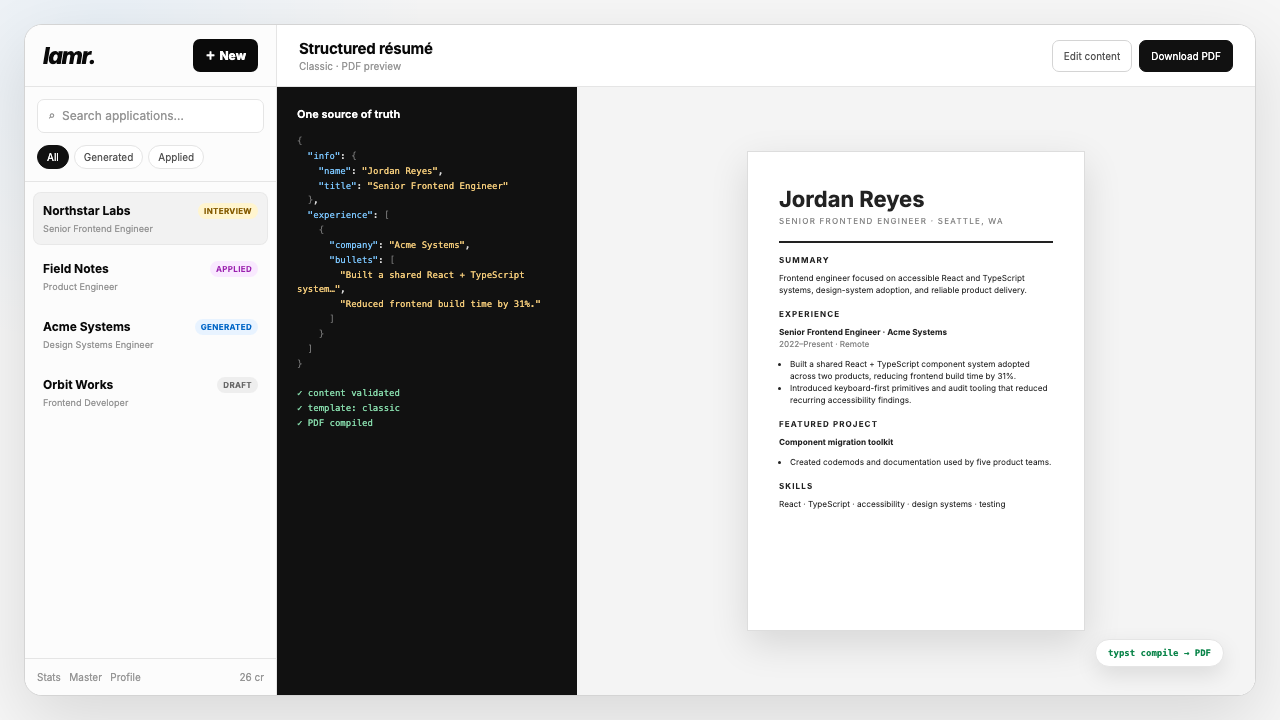
Templates are controlled renderers. The source data stays reusable, the output is deterministic, and a visual change never requires a second writing pass.
Each layout is a .typ document compiled by the Typst binary, with deliberate page geometry and typography.
Experience and skills stay in structured fields. Templates decide how those fields are arranged, never what they say.
Recompiling an existing draft does not invoke the writing model or spend generation credits.
Generate a résumé, a cover letter, or both. Matching Typst templates keep the two documents visually related.
Modern and Sidebar expose a small, tested palette instead of arbitrary styling that can break contrast or hierarchy.
Recent structured versions stay associated with the application, so document iteration is distinct from status history.
Treating layout as code buys determinism. It also rules some things out.
See how Lamr produces the structured tailored draft in the first place, and how each compiled version stays attached to the application it belongs to.
 Private alpha
Leave your email and you'll get an invite the moment the doors open — one email, no spam.