Paste the posting
Import a public job URL or paste the full description. Lamr extracts the company, role, hard skills, soft skills, and stated constraints.
Every tailoring tool promises a better resume. Almost none will tell you what they changed, or admit when the job is asking for something you have never done. Lamr maps the posting against the experience already in your master résumé, shows the evidence and the gaps, and hands you an editable draft — it will not turn an unevidenced keyword into a made-up accomplishment.
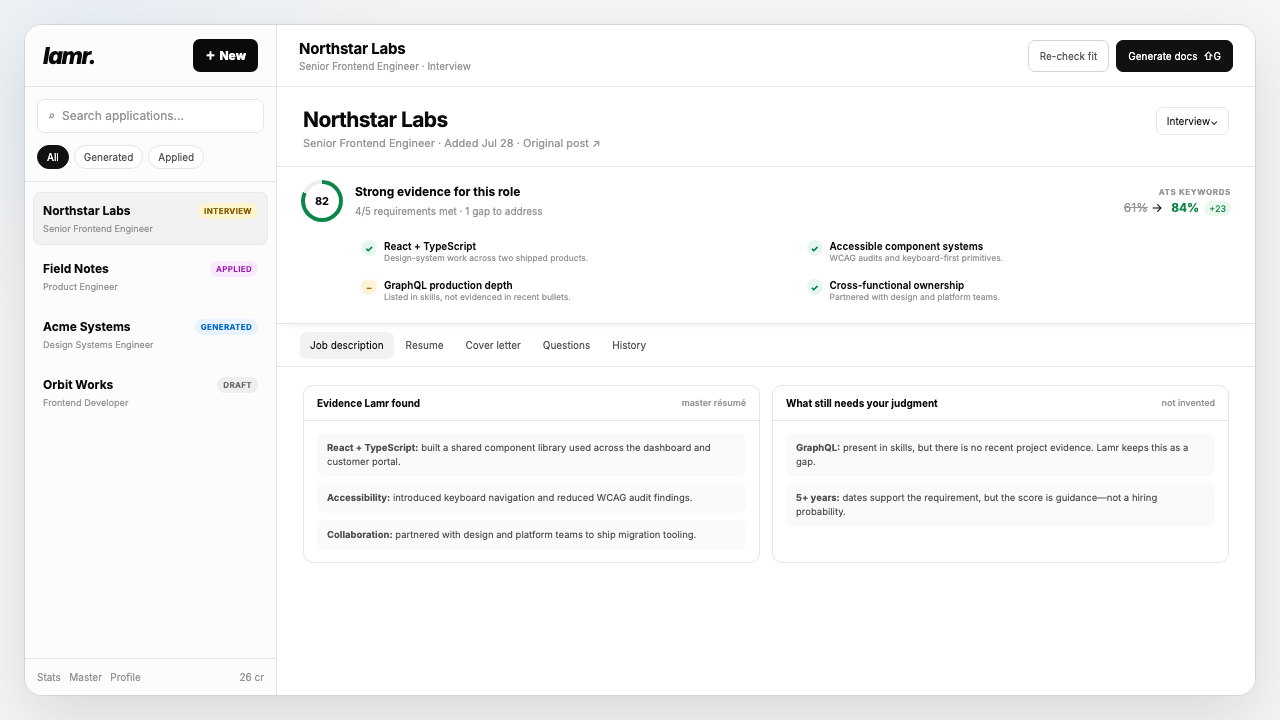
Most tailoring tools open by rewriting, which quietly assumes the application is worth sending. Lamr opens with a requirement-by-requirement check: what your background supports, what is partial, and what is missing outright. The score is a structured comparison you can audit line by line — not a prediction that a recruiter will call.
Live example — checked against a synthetic master résumé, the same way Lamr checks yours.
Analysis, writing, human review, and typesetting stay separate steps. Keeping them apart is what makes it obvious when AI is reasoning about evidence, when it is changing language, and when Typst is only moving ink on the page.
Import a public job URL or paste the full description. Lamr extracts the company, role, hard skills, soft skills, and stated constraints.
Every important requirement is marked met, partial, or missing, each one carrying the specific evidence from your master résumé that justifies the call.
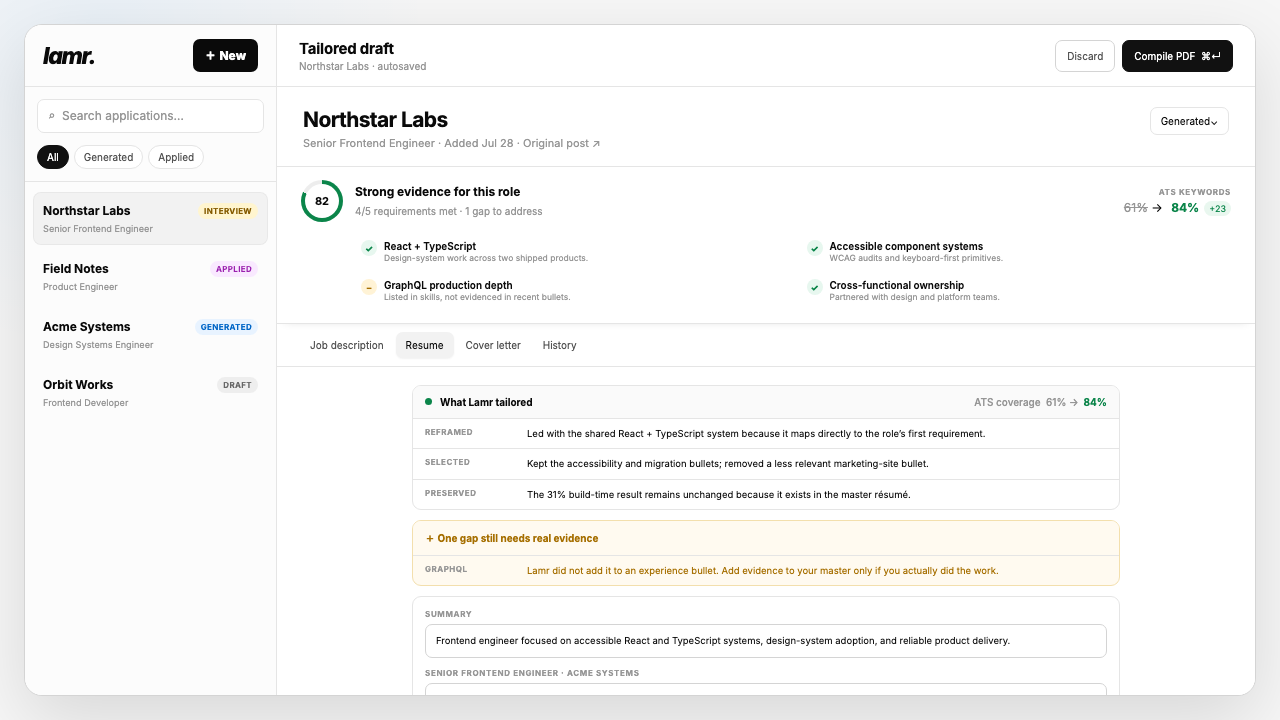
See what Lamr reframed, selected, or left alone. Titles, summaries, skills, and every bullet stay editable while the gaps sit beside them.
Compile the approved content into Classic, Modern, or Sidebar. Switching template or accent costs no additional AI call.
A posting asks for React, TypeScript, accessible component systems, cross-functional ownership, and production GraphQL. Here is exactly where Lamr will push, and exactly where it stops.
“Built a shared component library used across the dashboard and customer portal, reducing frontend build time by 31%.”
“Built a shared React + TypeScript component system adopted across two products, reducing frontend build time by 31%.” The technologies come from the candidate’s own skills and project record; the metric is untouched.
Production GraphQL depth is not evidenced. It stays a visible gap. Lamr asks you to add proof to the master résumé only if you genuinely have it — it will not manufacture the experience to raise a score.
Keyword lift on its own is trivial to game — paste the posting into the skills line and coverage jumps. Lamr pairs coverage with a short change log and keeps the unresolved gaps next to the editable content, so the last review is about accuracy rather than blind acceptance.
The useful work happens in the boundaries: one durable source résumé, visible requirement evidence, explicit content changes, and deterministic layout only after the writing is approved.
Every tailored version draws from one reusable source. Corrections belong in the master, so future applications inherit the better evidence automatically.
Requirements carry evidence and a status instead of collapsing into one unexplained percentage.
A generated metric that does not appear anywhere in your source material is flagged for confirmation before compile.
Change summaries, bullets, titles, skills, and section order all stay editable while the PDF does not exist yet.
Switching template or accent recompiles the same approved data. It never asks a model to rewrite the résumé again.
The posting, fit report, draft, PDF, notes, and status history all live on the same tracked application.
A tool that shows its work has to be honest about its edges too.
A tailored draft is only useful if it stays attached to the application it was written for, and only real if it compiles into something you can send.
 Private alpha
Leave your email and you'll get an invite the moment the doors open — one email, no spam.